Outbound Case Study

23 meetings in 75 days from a difficult-to-map U.S. venue market.

How custom market mapping, deep account research, personalized outreach and faster follow-up generated sales conversations for a food & beverage management company through the peak summer season.

23
Meetings booked
75 days
Campaign period
9,505
Prospects contacted
19,986
Emails sent
Campaigns launched June 16 and ran through the peak summer period.
The 75-Day Arc
Day 0 · June 16
Campaign launches
Outreach begins across a tightly restricted, custom-built venue market.
Weeks 1–2
Early momentum
Fewer than 2,000 emails generate 7+ meetings — an early signal the targeting and offer work.
July–August
The bottleneck moves
Peak summer season. Replies keep coming, but converting them into booked meetings gets much harder.
Mid-campaign
Warm calling introduced
Positive replies get called within 10–15 minutes, before interest goes cold.
Day 75
23 meetings booked
Across 9,505 prospects and 19,986 emails, the program closes at 23 sales meetings.
Context

The client sold food & beverage management into large U.S. venues.

I managed outbound for a food & beverage management and facilities company selling into stadiums, arenas, amphitheaters and other large entertainment venues.

The offer itself was strong. The harder problem was finding enough of the right venues, finding enough legitimate ways into each account, and converting interest during one of the busiest periods of the year for the market.

The campaigns launched June 16. Roughly 75 days later, the program had generated 23 meetings.

This wasn't a market where we could burn through an unlimited list.

1,000+
Minimum venue capacity
13
Initial target states

At the beginning of the engagement, a venue needed to have at least 1,000 seats and fall inside approximately 13 southeastern U.S. states. That made the reachable account universe finite.

When the market is limited, you cannot compensate for weak targeting by continuously exporting another 50,000 contacts. Every viable account matters. And inside each account, we needed to find as many legitimate paths to the right person as possible.

Market Mapping

The hardest part was building the market itself.

Traditional B2B databases were not enough. Many of the venues had weak LinkedIn presence, unclear decision-maker information, and inconsistent company data — difficult to identify through normal B2B filters, with multiple potential contact routes.

We initially considered Wikipedia as a venue source. Then we realized that Google Maps provided much broader coverage of the venues we wanted to reach. Google Maps became one of the foundations of the account-mapping process.

Data Workflow
Google Maps
Venue discovery
Claude Code
Scraping, structuring and working through venue data
Claygent
Capacity research + decision-maker discovery
Websites + Facebook
Additional business/contact routes
Role Qualification
Determine which contacts were actually relevant
Waterfall Enrichment
Find usable emails
Multiple POCs per Account
Maximize legitimate entry points into a limited market

Finding a venue was not enough. The client required a minimum capacity of 1,000 seats, so records also had to be researched and enriched with venue-capacity information. The actual workflow was closer to: find venue → determine capacity → qualify account → identify relevant contacts → find email routes → research → outreach.

A single contact per venue wasn't enough.

A major problem with this market was weak LinkedIn coverage. When the organization does not have a strong LinkedIn presence, even identifying who owns the decision can become difficult. So we deliberately built multiple legitimate entry points into every qualified account, then qualified and enriched each one.

One Qualified Venue
Website Business Email
Facebook-Listed Email
Named Decision-Maker
Owner (Where Relevant)
Claygent-Identified Contact

Claygent helped identify relevant decision-makers; contacts were qualified by role, then run through waterfall enrichment to find usable emails. The goal was not to contact random employees — it was to maximize the number of relevant paths into every valuable account.

The client's offer gave the outreach something real to work with.

The underlying food & beverage management offer was strong and relatively unsaturated. That mattered. Outbound cannot rescue an offer nobody wants. The campaign did not need to manufacture fake urgency.

The job was to find the right venue, reach the right person, create enough curiosity to earn a response, and convert that response into a conversation.

Messaging

With a limited market, generic messaging was too expensive.

Email 1
Initial outreach
Follow-up 1
~3 days later
Final follow-up
~3 days later

Because the viable audience was limited, prospect research was run across the leads. Email 1 and Email 2 used researched, personalized messaging built around individual accounts.

The first email wasn't trying to force every prospect onto a call.

We expected some skepticism around the offer. The initial goal was therefore to earn the positive reply first. Email 1 used a one-pager as the CTA. Once someone expressed interest, inbox management could take over and convert that interest into a meeting. Email 2 used a more direct CTA asking for a call.

Outreach → create interestPositive replyInbox managementMeeting

Generating the reply and converting the reply were two different jobs. That distinction became especially important later in the campaign.

The first two weeks moved quickly.

~1,500–2,000
Emails sent
7+
Meetings booked

During approximately the first two weeks, fewer than 2,000 emails generated more than seven meetings. That gave us an early signal that the targeting, offer and messaging were capable of producing interest. Then July and August changed the operating problem.

Have a market that doesn't sit neatly in a database?
Talk to Blinkins →
The Bottleneck Moved

Replies continued. Converting them became harder.

As the campaign moved deeper into July and August, venue operators were in the middle of peak summer season. Decision-makers were busy. Positive replies continued to come in, but converting those replies into booked meetings became much harder.

The problem was no longer simply "can we generate interest?" It became: how do we stop interested prospects from going cold before the meeting gets booked?

Campaign Snapshot

The campaign generated 1,452 replies from 9,505 prospects.
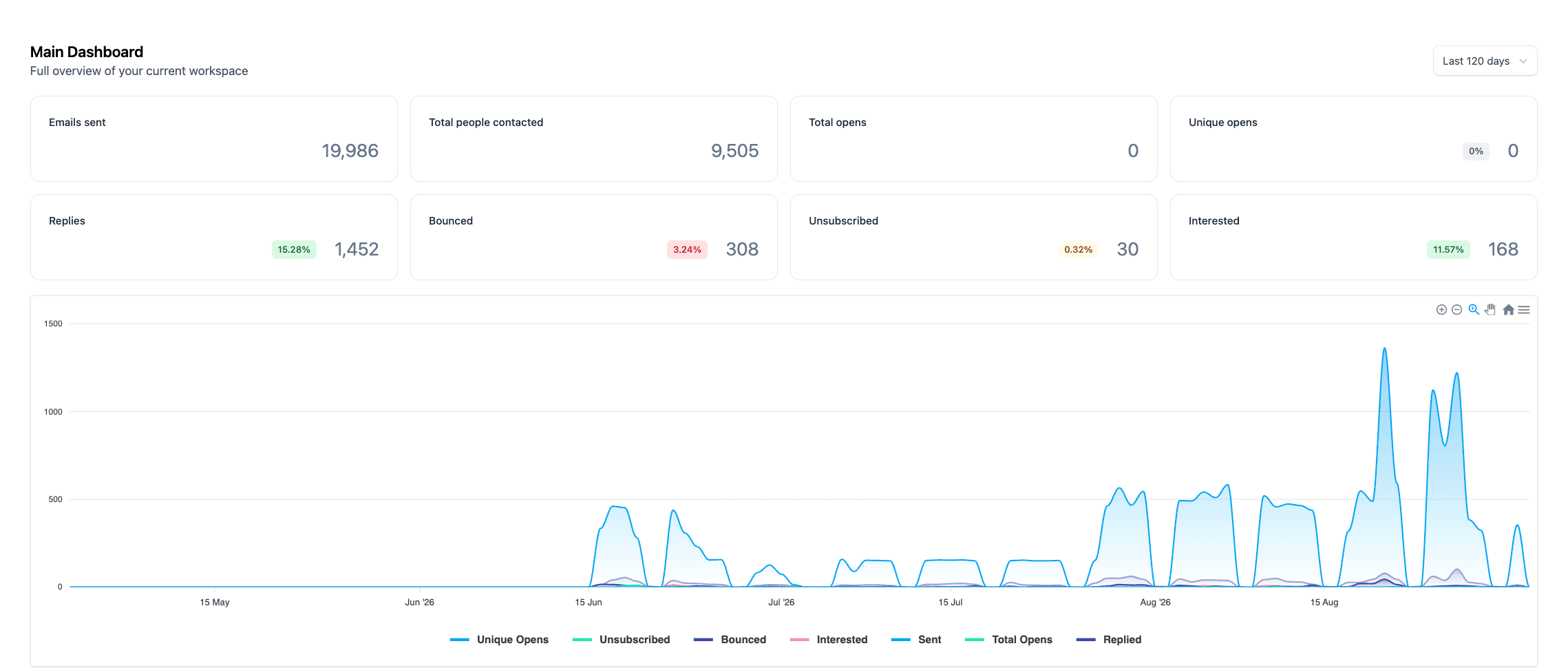
Outbound campaign dashboard from the venue engagement, showing 19,986 emails sent to 9,505 contacts and 1,452 replies.
Campaign dashboard snapshot from the engagement.
Prospects
9,505
Emails Sent
19,986
Replies
1,452
Meetings
23

19,986 emails were sent to 9,505 contacts, generating 1,452 replies and a 15.28% dashboard reply rate. The dashboard also shows 168 replies tagged as Interested.

Some Interested replies were tagged incorrectly during inbox management, so the Interested percentage is not used as a primary performance claim in this case study. The metric we use as the core outcome is the one we can verify directly: 23 meetings booked.

Generating interest was only half the job.

Inbox Management
We changed the inbox-management approach to make sure interested prospects were handled more tightly — preventing positive replies from sitting long enough to lose momentum.
Warm Calling
Positive leads could be called within approximately 10–15 minutes after replying. They're interested now — don't wait until they're cold.

Warm calling gave the team another route from positive email reply to actual sales conversation, rather than relying entirely on asynchronous email follow-up. The campaign experience showed a substantial improvement in reply-to-meeting conversion after these changes.

The original 13-state TAM eventually became too restrictive.

Data availability remained one of the biggest constraints. Eventually, limiting the campaign to the original southeastern states made continued scale difficult. The client expanded the approved geography across the United States.

That allowed the account universe to grow significantly and helped us reach the eventual total of 9,505 prospects. Even after expanding geographically, the strategy remained: maximize legitimate contact routes inside qualified organizations rather than treating every account as a single contact.

The account also had to work through bounce problems.

Early in the engagement, bounce rates were too high. We investigated the issue and removed security-gated ESPs / email environments that were contributing disproportionately to the bounce problem.

308
Bounces
3.24%
Bounce rate

The campaign had to adapt across data availability, qualification, deliverability, reply-to-meeting conversion, seasonality and inbox management — not a straight line from launch to result.

The Result

23 meetings in 75 days.

23
Meetings booked
75
Days
9,505
Prospects contacted
19,986
Emails sent

The campaigns ran directly through peak summer. The account began with a tightly restricted market. Venue data had to be assembled from nontraditional sources. Capacity had to be researched. Multiple contacts were pursued inside qualified organizations. Deliverability issues had to be corrected. Positive replies required a stronger conversion layer. Warm calling was introduced. And across the 75-day period, 23 sales meetings were booked.

Pipeline Still in Motion

The meetings are the beginning of the sales cycle — not the end.

The client sells large food & beverage management contracts with a typical sales cycle of approximately 6–9 months. As of this case study being written, the client is actively progressing conversations with three companies generated through the outbound program.

These are substantial opportunities, with potential contract values in the seven-figure range. The client remains optimistic about the opportunities, but none should be treated as closed revenue until an agreement is signed.

3
Active opportunities
6–9 months
Typical sales cycle
$1M+
Potential contract size for a successful deal

Across roughly three months, the client invested approximately $12,000 into the outbound engagement. At this deal size, even one successful contract would create highly asymmetric economics relative to the cost of the outbound program.

Illustrative contract-value-to-spend economics, based on a future successful close — not a realized outcome: a $1M contract would equal approximately 83× the $12,000 outbound spend in gross contract value; a $2M contract would equal approximately 167×.

Verified
23 meetings booked
Ongoing
3 active opportunities
6–9 mo cycle
Sales process underway
Closed deal
Not yet known

What made the campaign work.

01
Treat list building as strategy.
The market could not be pulled cleanly from one database. We had to construct it.
02
Maximize each qualified account.
A limited TAM meant every viable venue mattered. Multiple legitimate POCs and contact routes increased the number of ways into valuable accounts.
03
Invest more research where the TAM justifies it.
With fewer accounts worth contacting, deeper prospect research was worth the effort.
04
Separate reply generation from meeting conversion.
The email creates interest. The conversion layer turns that interest into a sales conversation.
05
Fix the bottleneck that exists now.
Initially, the bottleneck was finding enough qualified accounts. Later, it became converting positive replies during summer. The operating strategy had to change with it.
06
Do not use seasonality as an excuse.
Summer made this account harder. The solution was not to conclude that outbound could not work. It was to adapt the execution.

A positive reply is not the finish line.

This engagement is a good example of why outbound cannot be reduced to buy a list, write an email, launch a sequence. The work happened across the entire chain:

Market MappingAccount QualificationDecision-Maker DiscoveryContact EnrichmentProspect ResearchMessagingDeliverabilityRepliesInbox ManagementWarm CallingQualificationMeetings

When one part became the bottleneck, that was the part that needed attention. That is ultimately how a constrained venue market produced 23 meetings in 75 days through peak summer.

About This Case Study

This case study documents work I personally performed and managed before founding Blinkins Media.

— Jiten Khatri
Founder, Blinkins Media
Related
How the Blinkins outbound system works →What managed B2B outbound includes →More Blinkins results and case studies →
Have a market that's difficult to map?

Let's figure out the route in.

If your buyers do not sit neatly inside a database — or your outbound program needs more than another list and sequence — let's look at the market together.

Talk to Blinkins →