How a recently funded AI-agent company used multiple go-to-market motions, deep segmentation, personalized outreach, lead magnets and high-volume testing to create sales conversations through July and August.
The client was a recently funded AI company building multiple agentic-AI products designed to automate customer service and other business operations. The addressable market was broad — manufacturing, automotive, healthcare, insurance, financial services, blue-collar services, home services, local businesses.
But breadth was also the problem. AI agents were already being pitched aggressively, and prospects in many traditional industries were receiving a constant stream of similar claims.
So this was never going to be a build-one-list, write-one-sequence, wait-for-meetings account. The program needed enough scale to learn quickly — and enough segmentation to avoid treating a massive market like one audience.
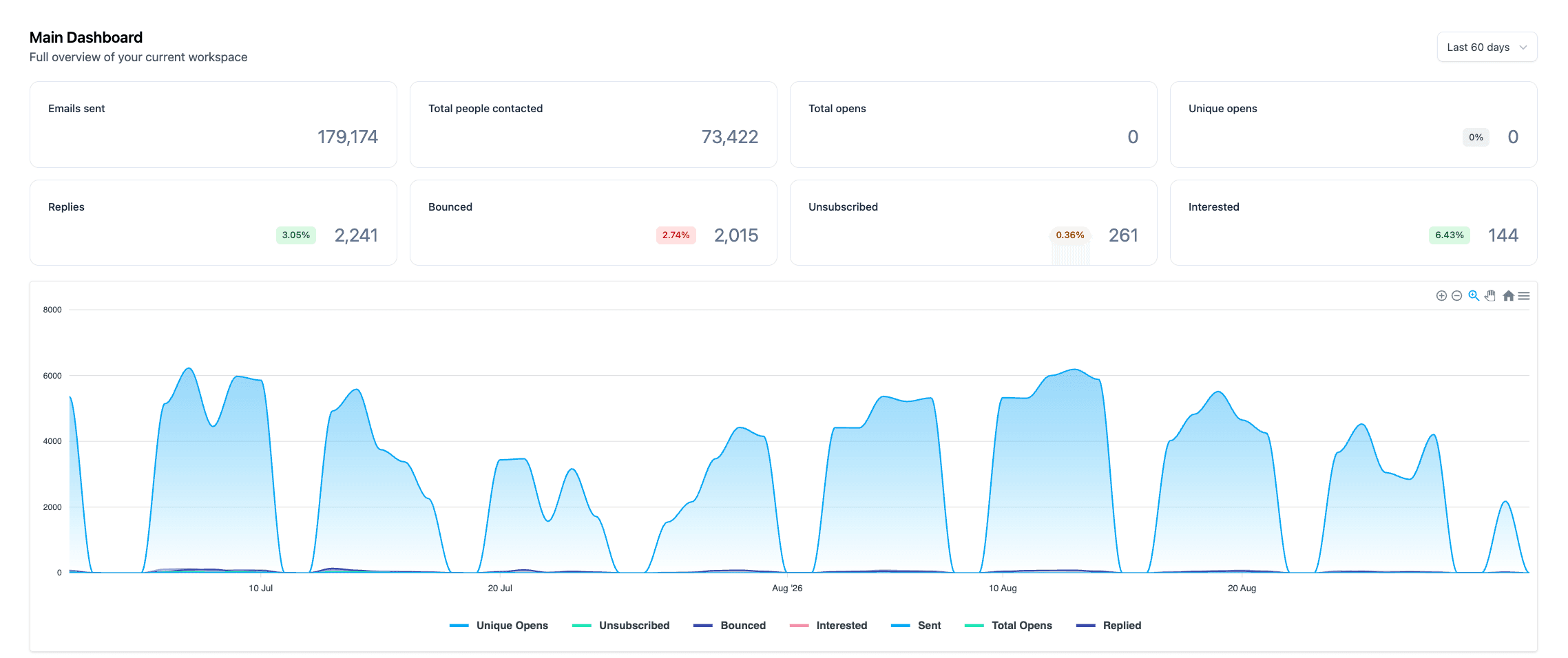
This was a high-volume account. Early in the engagement, campaigns were commonly operating around 3,500–4,000 emails/day, later reaching roughly 4,000–6,000 emails/day depending on campaign activity.
That wasn't an attempt to compensate for a tiny market — it was the opposite. The client had a very large TAM, and the AI-agent category was broad enough to support significant testing volume: testing markets faster, comparing offers, testing messaging, identifying responsive segments, running multiple motions simultaneously, and continuing to generate opportunities despite summer-season softness.
Each motion required a different answer to who to target, why they should care, what industries make sense, what the offer should look like, and what the CTA should be. The strongest early traction came from the white-label and reseller motions, while the direct end-customer motion required more ICP experimentation.
Manufacturing. Automotive. Healthcare. These looked attractive on paper. But they were also being hit heavily by companies selling AI agents, AI chatbots and automation products. That saturation created skepticism.
Rather than treating the original ICP as fixed, we changed direction based on how the market was responding.
The end-customer campaigns began expanding into regional home-services businesses, other blue-collar service companies, auto dealerships and local businesses. Those markets showed stronger buying intent for the direct implementation of AI agents. A large TAM does not mean every part of the TAM deserves equal attention — the response data had to determine where the next campaign went.
One end-customer campaign targeted companies already using call-center technology. If a company was already investing in customer-service infrastructure, there was a more credible conversation to have around AI agents helping automate parts of that operation — including coverage outside normal human availability.
The campaigns were segmented into different categories, and prospect/company research was used to personalize outreach. Research incorporated the individual prospect, the company, technology being used, relevant triggers and other useful account context. Subject lines were personalized as well, intended to feel contextual and familiar rather than like generic promotional lines.
Email 1 was kept below roughly 100 words. Email 2 stayed below approximately 120 words.
Open tracking was disabled on the dashboard for this workspace, so this case study does not claim a measured open-rate improvement from personalization.
As the market responded, the program increasingly optimized for positive engagement first, rather than insisting that every cold prospect immediately book a sales call. That led to another important part of the account: lead magnets.
We created approximately 4–5 different lead magnets and tested them across reseller, white-label and end-customer campaigns. One example was a calculator-style resource designed to show a prospect what businesses like theirs might be capturing that they were potentially missing. The CTA was intentionally lighter: "Want me to send it?"

The 144 Interested replies should not be read as 144 sales opportunities that failed to become meetings. Some campaigns inside this workspace weren't designed to book meetings at all — some were launched to drive cold traffic to the client's website, promote an event, distribute lead magnets, or create awareness rather than immediate calls.
Because the dashboard aggregates those motions together, the workspace-level Interested count mixes campaigns with different intended outcomes. The verified meeting outcome for the 60-day period is 15 meetings booked.
The campaigns ran through peak U.S. summer season, when the account saw more out-of-office responses, a drop in positive-response volume, and more difficulty converting positive replies into booked meetings.
The solution wasn't simply to stop. Instead, the account continued launching more campaigns, testing more markets, running A/B tests, rotating offers, testing lead magnets, and increasing volume where appropriate — at points reaching around 4,000–6,000 emails/day, helping offset softness in responses while the team kept learning which markets and offers were producing traction.
This account did not rely on finding one "perfect campaign." It relied on repeatedly answering: which motion (white label, reseller, end customer)? Which industry (traditional enterprise, blue-collar, home services, local business)? Which context (technology in use, operational trigger, company research)? Which conversion path (direct meeting, lead magnet, website traffic, event promotion)?
Then taking the response data and deciding what deserved more volume — extensive campaign testing and A/B testing were part of maintaining traction through the summer period.
While simultaneously testing 3 commercial motions, multiple ICPs, different verticals, technology-based segmentation, one-to-one personalization, personalized subject lines, different offers, 4–5 lead magnets, website-driving campaigns, event campaigns, direct meeting campaigns, A/B tests and high-volume execution. The result wasn't produced by one clever email — it came from continuously figuring out which market, which offer, which buyer and which conversion path deserved the next campaign.
The client had enough TAM to send at scale. But scale alone was never the strategy. The actual work looked like a continuous feedback loop:
That feedback loop is what allowed the program to continue finding traction inside a heavily saturated AI category.
This case study documents work I personally performed and managed before founding Blinkins Media.
If your TAM is large but every buyer is already receiving the same pitch, we can look at the market, break it apart and identify better routes in.
Talk to Blinkins →